


Leadership & execution

An SME does not always lack strategy. It often lacks the capacity to execute it.
Having a direction is not enough. You also need the ability to move forward.

The real challenge is not always the plan. It is execution.
A plan may be relevant, the priorities known and the team capable - without the company actually moving forward. Behind this “execution gap” lies less a lack of will than a mix of competing priorities, blurred responsibilities, unprotected resources and decisions that come too late.
It is 8:30 a.m. The management committee meets.
On the table: improve margins, deploy the new ERP, professionalise sales, recruit two key profiles, automate part of the administration, manage inventory better and reduce delivery delays.
No one disputes the objectives.
The problem starts after the meeting.
At 10 a.m., a client calls. At 10:30, someone is absent. At 11, a supplier announces a delay. After lunch, an important proposal has to go out. The next day, a production issue requires the manager’s attention.
Three weeks pass.
The projects are still “priorities”. They have simply stopped moving forward.
There is nothing exceptional about this scene. And it raises a less comfortable question than a strategy exercise: what if the company knew perfectly well what it had to do, but simply had not built the capacity to do it?
of companies in Belgium’s non-financial business sector are SMEs.
SMEs also account for around 64% of employment in this scope. Their size is both their strength - proximity, speed, a short distance between decision and operations - and a constraint: the same people often combine operations, management, development and transformation. [1]
Distinguish a genuine strategy problem from an execution-capacity problem - then test your priority projects with six questions.
The “strategy problem” is sometimes too quick a diagnosis
When a project stalls, the reflex is often to revisit the strategy.
New workshop. New plan. New objectives. New dashboard.
That can of course be necessary. A bad strategy remains a bad strategy.
But management research suggests distinguishing more carefully between the quality of the strategy and the organisation’s capacity to turn it into action.
Donald Sull and his co-authors studied strategy execution among 7,600 managers in 262 companies across 30 industries. Their work highlights problems of coordination, understanding priorities and adaptation, rather than simply a lack of vertical alignment. Their sample mainly concerns large organisations, so it would be misleading to transpose their statistics directly to SMEs. But the mechanisms observed are instructive. [2]
In a complementary analysis covering 124 organisations, only 28% of senior executives and managers responsible for execution could list three strategic priorities of their company. Again, this figure is not a benchmark for Belgian SMEs; above all, it reveals the distance that can exist between an officially formulated strategy and a strategy that is actually usable for decision-making. [2]
A strategy is truly operational only when it allows people on the ground to answer very concrete questions: What comes before what? Who decides? Which resource is reserved? What can we stop? And what do we do when an unforeseen event makes the original plan impossible?
Without answers to these questions, a strategic priority often remains an intention.
Management is not the administrative layer of strategy
There is a temptation to view management practices - routines, indicators, responsibilities, monitoring, problem solving - as “mechanics” that come after the real strategic decisions.
The data nevertheless suggest that they are far more central.
For nearly two decades, the World Management Survey has accumulated comparable data on management practices across thousands of organisations. Its work shows large differences in management quality between companies and a robust association between better practices and productivity, profitability, growth and even company survival. [3]
One particularly interesting field experiment went beyond simple correlation. Researchers intensively supported a group of Indian textile plants in adopting management practices relating in particular to quality, inventories and production monitoring, while a control group received a much more limited intervention. In this specific context, the supported plants increased productivity by around 11%. [4]
An experiment conducted in the Indian textile industry should obviously not be turned into a universal recipe for a Walloon service SME.
Its lesson is more interesting than that: work organisation, information flows, performance monitoring and management routines can change actual performance.
In other words, between strategy and results lies an execution infrastructure. And that infrastructure is not an administrative formality.
Between strategy and results lies an execution infrastructure. And that infrastructure is not an administrative formality.
Bandwidth: the invisible problem.
The word “priority” does not create any extra hours.

In an SME, the problem is often bandwidth
Large companies suffer from silos, slowness and complexity.
Small companies face another form of constraint: concentrated responsibilities.
The sales director may still be the best salesperson. The operations manager also handles several sensitive clients. The company leader arbitrates investments, gets involved in recruitment, approves unusual pricing and keeps an eye on cash flow.
Then the company launches an ERP. Or a sales transformation. Or a new organisation.
Strategy is then added to existing work instead of replacing it.
The OECD specifically identifies management skills, project management, the ability to coordinate actions and internal leadership among the important capabilities that enable SMEs to grow. It also notes that smaller organisations face greater difficulty attracting and retaining certain skills. [5]
This point profoundly changes how execution should be viewed.
A company may have a profitable project, a capable owner, management support and an available budget - and still lack the human capacity that can actually be mobilised when the project needs to move forward.
That is why asking “Who is responsible?” is not enough. The real question is often: “How much time does this person actually have this week to move this topic forward?”
“How much time does this person actually have this week to move this topic forward?”
Prioritising also means giving things up.
Strategy becomes real when resources follow the choices.

A priority without capacity is not really a priority
Every company knows this contradiction.
A project is declared strategic, but the person responsible has to deal with it “when they have time”. So there is no dedicated capacity. Then day-to-day work takes over.
The problem is not a lack of commitment. The problem is arithmetic.
A day remains a day. And five people occupied at 100% do not mysteriously develop a sixth unit of capacity because a project has been labelled strategic.
This is one of the interesting lessons from a case documented by the MIT Center for Information Systems Research at BBVA. The company gradually linked prioritisation, talent allocation and execution in the same quarterly process: initiatives are compared, human resources are assigned according to priorities, and individual owners are explicitly held accountable for delivery and value creation. [6]
The lesson is not to copy the system of a large bank. It is much simpler: the project portfolio and the resource portfolio must be decided together.
Yet many organisations do exactly the opposite. They choose their projects first. Then they discover that five “priority” projects need the same three people. At that point, failure is already partly built into the system.
Too many priorities turn strategy into noise
The difficulty is not only choosing what the company will do. It is choosing what it will not do now.
This is probably one of the most uncomfortable responsibilities of leadership. Because competing projects are generally not absurd.
The CRM is useful. The ERP is useful. The new offer is useful. Financial reporting is useful. Quality certification is useful. Process redesign is useful.
The difficulty comes precisely from this: several good ideas can collectively amount to poor resource allocation.
Strategy then starts to look like a wish list. No one knows what should give way when two priorities conflict. And that is when the word “priority” loses its meaning.
Sull emphasises this point: useful strategic priorities must guide everyday trade-offs, not simply state ambitions. His approach also rejects the idea that success means following the plan at all costs. [2]
Strategy is therefore as much a system of renunciation as a system of ambition.
benefits from delayed investments
management attention absorbed
competing projects drawing on the same resources
implementation and time-to-market delayed
extended change costs
initiatives postponed due to lack of bandwidth

Execution does not mean obeying the plan.
The field does not read the plan. It lives with its trade-offs.
Execution is not obedience to the plan
Here is another common confusion.
The plan was decided in January. It is now April. The client has changed. An employee has left. New regulation is coming. A competitor reacts. A technology suddenly becomes accessible.
Should the plan be followed? Not necessarily.
In its Pulse of the Profession 2024 study, the Project Management Institute observes that teams can achieve good performance with predictive, hybrid or agile approaches. The choice of method matters less than the organisation’s ability to adapt it to the context, develop skills and give teams enough autonomy. [7]
This puts one idea back in its proper place: a good execution system does not guarantee that the original plan will be executed. It guarantees that the right trade-offs will be made when the plan meets reality.
Management therefore should not only ask: “Are we on schedule?” It should also allow the question: “Does this initiative still deserve the resources we are devoting to it?”
A company capable of stopping a bad project quickly may outperform a company that is extremely disciplined in executing a project that has become pointless.
The real role of middle managers
In many SMEs, the term “middle management” may almost sound too grand for the organisation.
Yet there is always a translation layer between leadership and execution: production manager, sales manager, project manager, team leader, administrative manager.
These people turn a general intention into concrete decisions.
Research shows that they are not merely responsible for passing on instructions. They interpret strategy, translate it into operations, bring information back up and contribute to adapting it. [8]
This is precisely why a strategy can be perfectly understood by the CEO and still disappear before reaching the field.
Between the two, someone has to resolve the contradictions: “increase revenue” but “protect margin”; “move faster” but “make no mistakes”; “launch the ERP” but “do not reduce production”; “give more autonomy” but “have sensitive decisions approved”.
This work of making trade-offs is execution. And it requires more than a PowerPoint.
if the value remains
if the opportunity grows
if the assumption changes
if the project no longer makes sense
A good execution system does not guarantee that the original plan will be executed. It guarantees that the right trade-offs will be made when the plan meets reality.
Holding someone accountable without giving them the necessary time, information, resources and authority does not create accountability. It simply shifts the problem.
The LUCID execution framework.
An operational synthesis of recurring mechanisms in research on management, execution and portfolio steering. It is not a universal scientific standard, but a reading framework designed for the realities of SMEs.
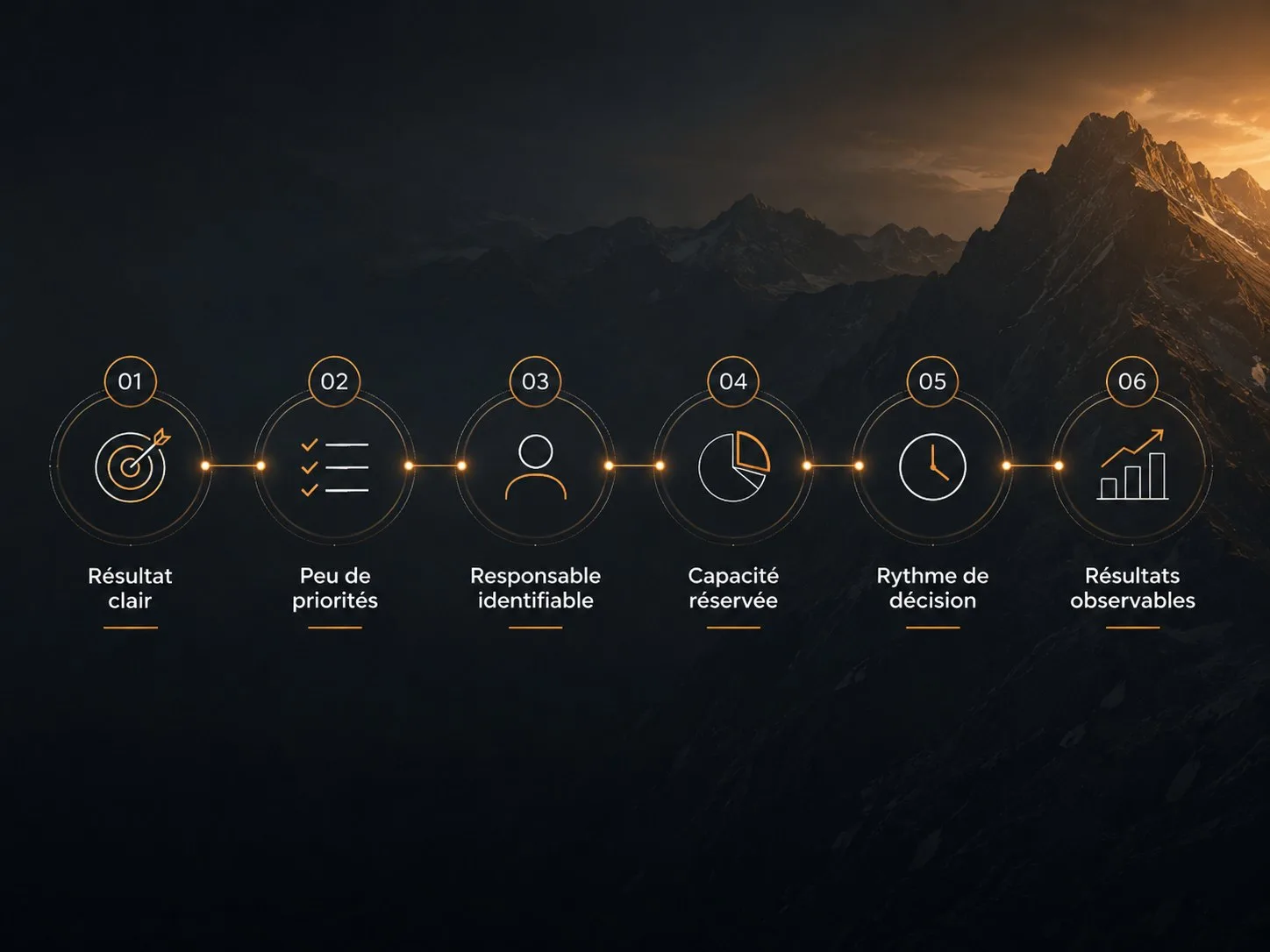
A clear outcome
Not “implement a CRM”, but “have a reliable pipeline used by the whole team that allows sales to be forecast three months ahead”. The deliverable is not the objective.
Few priorities
A new priority must trigger a capacity conversation: what are we delaying, suspending or stopping?
An identifiable owner
Not “the committee”. Not “the team”. One person able to answer: “Yes, I own its progress.”
Reserved capacity
Time, the necessary skills, sufficient authority to decide and resources that are genuinely available. A priority without capacity is an intention.
A decision rhythm
Weekly, fortnightly or monthly depending on the initiative. A moment when it is genuinely possible to continue, accelerate, make trade-offs, modify or stop.
Observable outcomes
A good indicator is not there to make a dashboard look better. It must make it possible to detect early enough that an assumption no longer holds.
Execution rarely fails because an organisation does not know that Gantt charts, KPIs or RACIs exist. It fails when simple mechanisms do not hold over time.
The Monday morning test
Take the five projects currently presented as the most important. For each one, ask these six questions. If the answers are immediately available, the system probably exists.
Tick the statements that are true. In the PDF version, the boxes are interactive in compatible readers.
solid foundations
likely realignment
the problem may be less strategic than organisational.
Which initiative remains officially a priority in your company even though no concrete decision has been made about it for thirty days?
Run the execution diagnosisExecution capacity is itself a strategic choice
Belgian SMEs will continue to have to invest, digitalise, recruit, improve their processes and adapt their models. European data also show that their economic weight remains considerable, while recent OECD work highlights the growing importance of the multiple skills needed to navigate digital and environmental transformations. [1] [5]
But accumulating transformations does not create transformation capacity.
The difference is fundamental.
An organisation does not become more agile because it launches more projects. It becomes more agile when it knows how to choose, sequence, resource, decide, learn and stop.
This may ultimately be where the real gap between strategy and execution lies.
Not between the people who think and those who act. Not between the management committee and the field.
But between what the company says it wants to accomplish and what it is actually willing to protect in time, attention and resources.
Strategy sets the direction. Execution begins when that direction forces choices to be made.
And sometimes, the first strategic act of a company is not to launch a new initiative.
It is finally deciding which one it will actually finish.
The first strategic act is not always to launch a new initiative. Sometimes it is deciding which one will actually be finished.
1. European Commission - SME Performance Review 2025, Belgium factsheet.
5. OECD - Strengthening SMEs and Entrepreneurship for Productivity and Inclusive Growth.
2. Sull, Homkes & Sull - Why Strategy Execution Unravels, MIT Sloan Management Review.
6. MIT CISR - Four Principles for Strategy Execution, BBVA case.
3. World Management Survey - management practices and performance.
7. Project Management Institute - Pulse of the Profession 2024.
4. Bloom et al. - Does Management Matter? Evidence from India, NBER.
8. Journal of Management & Organization - Making strategy work: the role of the middle manager.
The often-repeated figure that “70% of strategies fail” was not retained: its definition and traceability vary too much across sources for it to be treated as a solid journalistic fact.
Turning intention into impact
LUCID helps SMEs clarify, structure and steer execution so that it becomes a genuine performance lever.
lucid.dtsc.be • lucid@dtsc.be
LUCID supports SMEs when an issue goes beyond advice and requires framing, operational capacity and execution alongside the teams.
Written and created by Junior Cantos for LUCID by DTSC
SME Management by DT Services & Consulting
09
The first 30-minute conversation is free. That's where it gets framed, with no commitment.